Wham! – Wake Me Up Before You Go-Go
Wham! – Wake Me Up Before You Go-Go
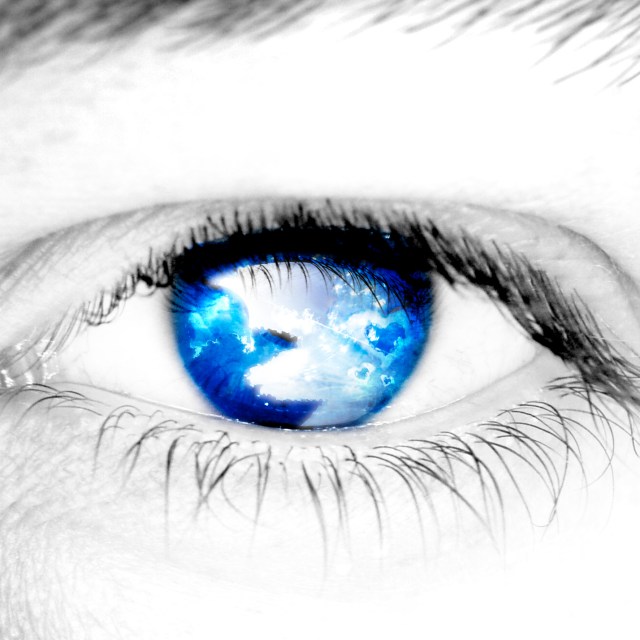
Outer eyes
Cannot see themselves.
The inner eye
Is its own reflection
When we look we can see many things, but the eyes cannot see themselves without the help of a mirror. We are not used to introspection. Although the followers of Tao say to look within to gain self-awareness, we will be confused if we use the attitudes formed by looking with our eyes.
That is why it is important to make a clear distinction early on. Do not try to understand yourself with the attitudes of physical seeing. Look within using inner vision.
For centuries, people of many different cultures have referred to the “mind’s eye,” or the “inner eye,” or the “third eye.” These are all indications that there is a separate way of looking within. In meditation, it is important to discover and utilize this mode of introspection. We must go beyond thought, go beyond visualization, go beyond imagination and actually open a part of the mind that most people leave dormant. This inner eye has a location, buried deep in the brain. When it is opened, it is our way of receiving more subtle experiences than we receive in our physical states. Perhaps looking and seeing are misleading terms, after all. We don’t necessarily “see” images through this inner eye : We gain direct awareness that is beyond the image.

Imagination, song, the soaring spirit.
Separate them to know them as aspects of the whole,
Join them to know the mystery of totality.
The mind, if focused, can become the most powerful force we know. Yet for most of us, we are lost in the vastness of our own uncharted minds. We play around with different aspects, find certain modes that we can get by with, and leave the rest unexplored. Those who follow Tao do not do this. They want to explore all the dimensions of the mind so that they may find a wholly integral mode of consciousness.
The primary means of exploration is through concentration of the mind. Practitioners first select an aspect and delve into it by daily focus. Only when they have fully understood do they go on. It is like studying. When you are first introduced to a subject, you must put your attention to work in order to master the knowledge. Such concentration leads to absorption, like mixing liquids together in a bottle : Once they are combined, they cannot be distinguished from one another.
With concentration, all the various aspects of the mind can be joined together into one superconscious mode. Sound is the same as sight, taste is the same as smell, touch is the same as thought, and all that we are is identical with the spiritual energy that resides within us. In this high concentration, there is complete union, and we feel the joy of total integration with all our facets.
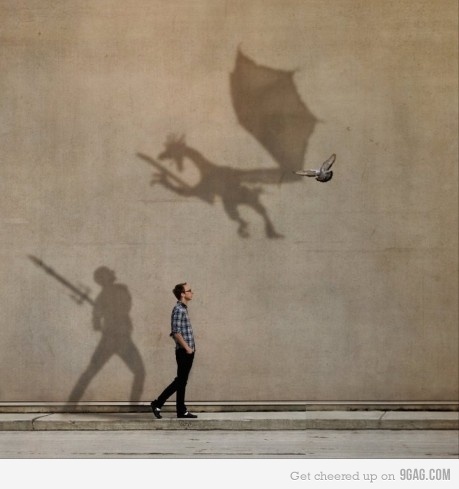
Imagination is pale and fragile,
Dreams grip with a false reality.
Imagination can build bridges,
Dreams can deceive.
When we dream, the experience is often deeply involving. Frightening dreams make us awake trembling and sweating. Pleasurable dreams leave us with lingering desires. Certain dreams are a form of healing, a way for our minds to recircuit and adjust themselves. No matter what, these dreams have no objective reality in our waking world.
Imagination is also a form of mental involvement. It is a way of projecting our thoughts into believable images to be contemplated and manipulated. We can play with our imagination, use it to inspire creative projects.
Both imagination and dreams are similar activities of the mind, and yet they differ in the level of conscious participation that they permit. In the case of the dream, there is a total suspension of rationality and consciousness, so there is little or no direction possible. There is no mode of control. By contrast, imagination is a tool through which we can make our lives better, different, and creative. By cooperating with it, we can achieve things that “we never dreamed possible.”

Where was Tao while I was gone?
Wasn’t I following it where I went?
Do you think that there are two?
After traveling awhile, we come home to a familiar place, only we often look at it in a new light. Were things different while we weren’t here? We experienced so many new and different things while we were gone — wasn’t that Tao too? How can there be so many differences?
You might argue that a mountain is a mountain, but our attitudes toward it are changeable. If we mistake our subjective viewpoints as something that is solid, permanent, and never relative to circumstances, then we will have no end to our problems. However, if we always remember that everything is comparative, then we can move through life in a much more dynamic way.
There are not two ways. There is only one. It is so vast that we can experience widely diverging aspects of it and imagine that we are in different realities. This is a misconception. We cannot outrun Tao, cannot be outside of it. It is only our viewpoints that change to the degree that we think we are in differing dimensions. In the river of Tao, we are like minnows that can never plumb the length and breadth of the water.

We part at the crossroads,
You leave with your joys and problems,
I with mine. Alone, I look down the road.
Each one must walk one’s own path.
People’s paths come together all too briefly when sharing friendship, but that makes those times no less valuable. We must take advantage of support and sharing in a mutually beneficial way. Whenever we take from another, we should try to give back something. This is fundamental. No one should lean on another person, or expect another to carry them a long distance down the road. Friends should walk side by side for as long as their journey carries them, without becoming dependent on one another.
There should be no obligation. If I can help someone do something, then I should do so without any hesitation or expectation of reward or debt. If there is something that I need to learn and my companion can show it to me, then I should accept it in humility. No one “owns” knowledge. It should be freely shared.
Parting is inherent in all meeting. Nothing lasts forever. Transience is what gives life poignancy. Every person is responsible for himself or herself. There is no road to walk but your own
Blog for poet and singer-songwriter Malcolm Guite
Just Bob talking about his pipes and cigars
Our mission is to educate and spread awareness about puppy mills.
Cartoons by John Atkinson. ©John Atkinson, Wrong Hands
Entertainment news, film reviews, awards, film festivals, box office, entertainment industry conferences
Funny Blogs With A Hint Of Personal Development
~ in vino veritas ~
Memoirs of an Imperfect Soul
A humorous website of assorted madness
Travel & Life
photos in and around, here and there
Movies and TV and books, oh my!
The Modern Art of Muay Ski-Jitsu...
News and reviews from the world of gadgets, gear, apps and the web


 my mostly unfabulous life