Daily Tao / 341 – Simplicity

tao

“Be aware of Tao.”
Isn’t that simple?
No — let’s reduce more :
“Be Tao.”

Why go through all this rigmarole? Why endlessly examine scriptures and debate obscure actions of long-dead saints and equally dead words? We need to affirm experience over words, individuality over dogma.

After all this study of Tao, there should only be this simple conclusion : There is only us and Tao.

No, more simple still is to be Tao itself. Then everything that is Tao is us.

Those who follow Tao reduce everything in complexity until they reach the final irreducible conclusion : You are Tao. When you can be that without any contradictions, then you have truly achieved sublime simplicity.

Daily Tao / 340 – Context

ImageProxy-82

Context. Connection. Engagement.
If we understand these words,
We do not need esoteric terms.

We can say that Tao is the context for everything, but we must go deeper than that.

All things are relative to their surroundings and to us. Strictly speaking, something that is one way to us will be another way to someone else. It might be very subtle, but there will be differences worth considering.

What do we do with this understanding? First, we have to reconsider that all things are connected. Although the angles of relationships shift and differ for each of us, we must be aware of the actual connections and even take advantage of them.

Secondly, we have to understand that relationships are transitory. We must have constant awareness to fit ourselves into the changing constellations of life.

Thirdly, we have to understand the value of our own point of view. Out of this mass of changing concordances, we must pick out the coordinates by which we act at any given moment.

We should take comfort in this situation. As long as we engage life fully, we need not fear being separated from the essential current of life.

Daily Tao / 339 – Learning

heres-proof-that-learning-cursive-makes-you-smarter

Learning is the fountain of youth.
No matter how old you are,
You mustn’t stop growing.

Don’t think that creativity is only for artists, writers, and musicians. Creativity is an essential element for everyone. Unlike the outer-directed creativity of making art, solving problems, or writing, the creativity that everyone can engage in is learning.

As long as we continue to learn, welcome new ideas and ways of doing things, and continually expand our understanding of ourselves and the world around us, then we are engaging in the ultimate creativity of the self.

If one looks carefully at those seniors who are ongoing and vital participants in life, one will see that a common habit is continuous learning and interest. These seniors are not the same as they were in their youth. They have found new ways of learning and acting.

As we enter each new phase of our lives, the parameters change. If we are sixty, we cannot do the same activities that we did as teenagers. Therefore, we need to revamp ourselves according to our situation. That continuing act of creativity keeps us young.


Daily Tao / 338 – Expression

red_flag_abastract_expression_pop_art_wallpaper_jpg_Wallpaper_7kqmp

There’s nothing to paint anymore.
We’ve seen everything from the classical to the absurd.
There’s nothing to write anymore.
As many books are shredded as read.
There’s nothing to sing anymore.
The once avant-garde is now background music.

In a world where expression seems futile, it is hard to maintain creativity. But creativity is a primal impulse. Cave people painted on walls; everyone’s house has some image on display. Primitive scribes wrote records of their experiences; people still keep diaries. Early shamans sang; we still live with music. We cannot abandon creative expression in our daily lives, though it seems hard to come up with something new.

The only way to have fresh expression is to go deep within. In a sense, today’s extreme pluralism eliminates the obligation to do the same as others. At one time, artists, priests, writers, musicians, and craftsmen were obligated to their feudal lords. Today we are not constrained by hierarchical standards. We are free to commune directly with our inner callings.

By coincidence, this mirrors a more sophisticated understanding of the divine. We are no longer in a position of supplication with what is divine. Rather, divinity is a quality from within ourselves.

Daily Tao / 337 – Moderation

moderation

Alternate between the solitary and the social.
Whether alone or with others, keep serenity.

Some people argue that Tao can be known only through bitter asceticism. Others prefer massive congregations. But those who follow Tao are neither too solitary nor too gregarious. They have regular times of privacy. And they equally enjoy being with others.

Privacy is good. But an overly monastic life can lead to unhappiness, delusion, and even insanity. In the same way, relationships are good. But too much social intercourse can lead to conformity, conflict, and stress. Therefore, the way of Tao aims to maximize the good and minimize the bad.

We should have regular times to be alone, meditate alone, even sleep alone. This gives us clarity. Then we can bring this understanding to our relationships. Friendships will be all the more wonderful. Once we understand moderation, we move between the solitary and the social without any mistake.

Daily Tao / 336 – Wisdom

golden autumn

A white-haired couple sits on the park bench,
Reading the paper, discussing the day’s news.
He repeats a poem, learned in his youth;
She finishes the stanza as he nods in pleasure.
At twilight, the air seems clearer than noon.

In past times, educators emphasized memorization. You can still meet older people who can recite certain poems, passages from classics and religious texts, or mathematical formulae. In fact, some people assert that those who remember more are wiser.

Young people often have a mania for more and more information. But mere accumulation is not enough. The more you take in, the more that data needs to be managed. Without that, you have encyclopedic knowledge and minuscule wisdom. True wisdom is a qualitative value built on a quantitative foundation. The vital elderly did not become venerable through good memory alone. They also learned to manipulate those facts. They mixed their knowledge with a healthy dose of experience, experimentation, and contemplation. It takes time to intuit special connections between facts.

One might say that wisdom is not simply a mental process but the sum total of a human being.

Daily Tao / 335 – Prowess

Picture About Male Model Gui Costa Captured by Kuandi1

The wrestler was once more solid than a bull.
He loved to flex enormous, oiled forearms
Before he delightedly vanquished foes.
But now, brittle skin is taught over bone,
And his wheeze is a ghost of his manly bellow.

At any point in life, it is prudent to contemplate the nature of prowess. If you have it, glory in it, and use it wisely and compassionately. But you should not think that it is you yourself who are doing these things. You are borrowing this strength. It isn’t yours. It is a gift, something here for you for as long as you are lucky to have it. Once it passes, you will not have the victories, and you will be stuck with the same body and mind. When you have been humbled, what is gone? You are still here, here to feel the pain of not being able to do what you were once able to do — unless you learn how to exercise your prowess without identifying with it.

Those who fail to learn this become bitter old people. They curse life. They lose faith. That is because they placed all their self-worth in their abilities and not in who they were. That is why it is good to meditate, and to accumulate not victories but the experience of those victories. Savor them. No one can ever take that away from you.

It is the experiences that come out of prowess, not prowess itself, that are valuable.

Daily Tao / 334 – Dipper

a8fef1c45b9e72b48777ade9612afb87

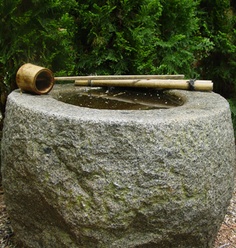
Bamboo dipper, granite basin.
Crust of ice over inky reservoir.
Moon shimmers in the dipper
Until fullness drains away.

Some people are like dippers. No matter what they try to gather up, it ends up flowing out again. For such people it is exceedingly difficult to accumulate anything in life.

If you are like the dipper, that is all the more reason to concentrate the resources that you have. Poverty of any kind need not be a deterrent if you know how to utilize the wealth you possess. You must embrace your fate, work with it, and take advantage of it.

Ultimately, we cannot truly grasp anything permanently in life. We are born naked, we die naked, and in point of fact we live naked. What we take to us — our clothes, our wealth, our relationships — are all external to us. They are easily taken away from us by bruising fate.

We try to internalize our experiences and our understanding. Even that can be taken away by stress, senility, poor memory, disorganized thinking, drugs, or shock. Truly, we are all dippers. The little that life offers us dribbles away.

Perhaps even the poorest of situations is rich, because all the futility of life leads us to embrace Tao. After all, it is bigger than all infinities and more subtle than the slightest wisp. To feel it requires great strength. To sense it requires a dragonfly’s delicacy. When you tire of trying to hold on to life, you will find the means to enter Tao.
Daily Tao / 333 – Donkey

10401137-a-free-donkey-grazing-on-the-mountain

Dismount your donkey at the summit.

Some places in this world are very hard to climb, and people use animals. Each person can only ride one, and each animal might have a different name. The riders go up the trail in different orders, and they discuss their varying opinions about their experiences. They may even have conflicting opinions : One traveler may think the trip thrilling, another may find it terrifying, and a third may find it banal.

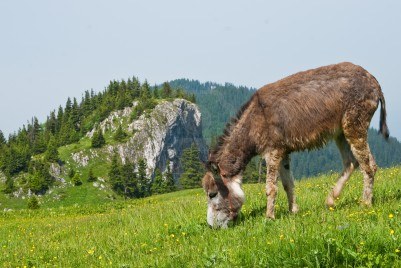
At the summit all the travelers stand in the same place. Each of them has the same chance to view the same vistas. The donkeys are put to rest and graze; they are not needed anymore.

We all travel the path of Tao. The donkeys are the various doctrines that each of us embraces. What does it matter which doctrine we embrace as long as it leads us to the summit? Your donkey might be a Zen donkey, mine might be a Tao donkey. There are Christian, Islamic, Jewish, and even Agnostic donkeys. All lead to the same place. Why poke fun at others over the name of their donkey? Aren’t you riding one yourself?

We should put aside both the donkeys and our interim experiences once we arrive at the summit. Whether we climbed in suffering or joy is immaterial; we are there. All religions have different names for the ways of getting to the holy summit. Once we reach the summit, we no longer need names, and we can experience all things directly.

Daily Tao / 332 – Dovetail

dovetail2

“Measure twice, cut once,” said the old craftsman.
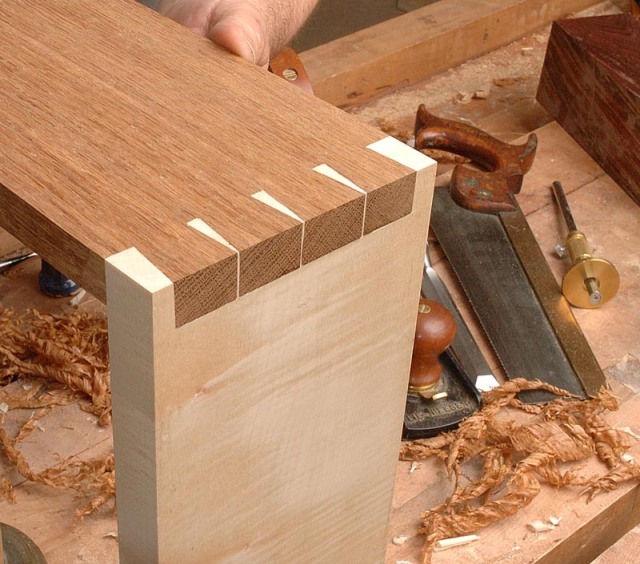
Only careful planning and patient skill make a dovetail.

Early cabinetmakers were faced with the problem of joining two pieces of wood together at a right angle so that they would bear the stress not only of use but of the weather as well. Especially in places where the summers are hot and humid and the winters are dry and cold, a plank of wood might change its dimensions by a quarter- to a half-inch. Quite enough to make joints fall apart and drawers stick!

The dovetail joint holds because the two interlocked pieces of wood expand and contract at the same rate. The direction of the pull is against the locking of the joint. The byproduct of all this fine craft is a joint so precisely fitted that it is a thing of beauty in and of itself.

Cutting a dovetail joint is a demanding skill. The lines must be laid out with great care, and the cutting must be carefully done using a thin saw. The waste must be slowly trimmed away with a sharp chisel until both sides mate tightly. The making of a dovetail joint requires planning, skill, and patience.

Nowadays, cheap synthetic materials do not breathe with the seasons. That might reduce inconvenience, but it has also reduced the chance for another relationship to Tao. For when the cabinetmakers sought to build furniture that was compatible with the wood, the seasons, and their own ingenuity, they were perfectly in tune with Tao.