Daily Tao / 93 – Confidence

confidence

Truth perceived gives assurance.
Skill yields self-reliance.
With courage, we can defy danger.
To increase power, increase humility.

Through constant contemplation, we can arrive at the truth. The more experienced we are, the more thorough our understanding, and thus the more we can come to rely on our knowledge. When we exercise what we know, it not only extends our understanding of the truth but helps us take action in meaningful ways. The more we do, the more self-reliant we are.

Every achievement brings a wonderful dividend of confidence. We try greater and greater ventures, until we are brave enough to accomplish undertakings far beyond what the average person imagines. When we reach that level of consummate skill, it is a time of both celebration and extreme caution. We are justified to rejoice, for this is the level of ability that we have been striving so long and hard to attain. It is also the time for caution because the foolish will eventually try something too great for them to handle. Pride and passion will lead to their downfall.

Therefore, the more accomplished one becomes, the more circumspect one should be. The higher one’s skills, the more precarious one’s road. The most powerful followers of Tao are also among the most humble. By veiling their light until the proper moments, they escape the greatest danger of all : hubris.

Daily Tao / 92 – Accuracy

perfect_shot_by_deargruadher-d4syoie

Make every move count.
Pick your target and hit it.
Perfect concentration means
Effortless flowing.

A life that is spiritual requires focused action. It needs quick reflexes, accurate timing, and abundant skill. That is why followers of Tao are always compounding their self-cultivation : They want the ability to do whatever they want.
Each day your life grows a day shorter. Make every move count. All that matters is accomplishing what you envision with the greatest dispatch. Once you do, that aspect of your interest is discharged, and you can then go on to some new interest. If you do not engage in this ongoing process of action, you will never satisfy all the various aspects of the soul, and realization will never fully mature for you.

Some assert that there is no end to desire, so we should undercut our ambition. But this doesn’t address the need for satisfaction. We need to have satisfaction in what we do in order to have a good sense of well-being. If we undercut our ambition, then we will never make any achievements nor satisfy our yearnings. This only leaves us with frustration, uncertainty, and timidity. Therefore, to follow Tao, we must identify our inner longings and dispatch them with a hunter’s accuracy.

Daily Tao / 91 – Funeral

780px-funeral_procession_goderich_ontario_1913

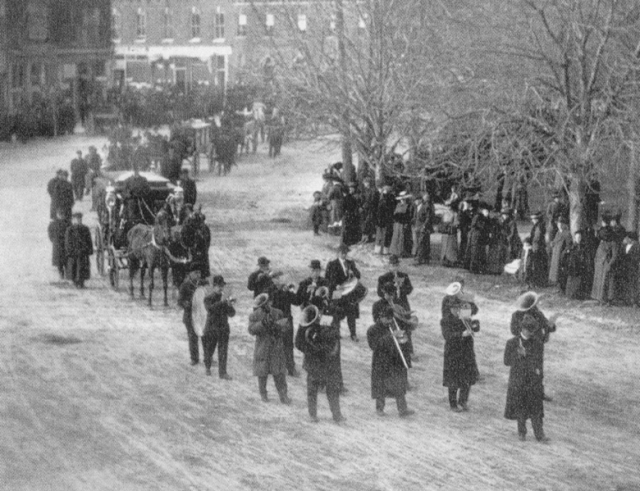
Hearse of weathered black enamel,
Undertakers fingering cigarettes.
Family, some crying, some bored,
Some only thinking of themselves.
Hired marching band out of tune.
Even in death we find no accord.

If you look closely at a dead person, can you truly see a soul? Is there anything left of the person that you knew? No. There is only a corpse, one that doesn’t even look familiar; whatever animates people is gone. Have they flown to heaven? Have they gone into some cycle of transmigration? I don’t know. Theories about what happens after death can only be conjecture.
A funeral is for those left behind. It is a ritual for us to come to grips with what has happened. Sometimes, one wonders if the weeping is more out of fear for ourselves than it is sympathy for the deceased.

All our lives, we seek union. We try to please our parents, we try to do well for our teachers and society, we try to make love and get married, we try to touch the universal through art, music, and meditation. Yet all our lives, our every attempt is flawed. Accord and harmony are transitory states. Their duration and quality come only from our determination. Once our mind gives way, we can no longer hold the connections that we want.

Don’t wait for death to solve your difficulties. Do what you must while you are alive.

Daily Tao / 90 – Longevity

200135171-001

Contemplate in the morning.
Pull weeds in the afternoon.
The joys and labor of a single day
Are part of a whole journey.

If all you want is spiritual realization, it isn’t that difficult. For the average person, a dozen years under the guidance of a good teacher will probably give it to you. That’s shorter than what it takes to be a good musician, athlete, or artist. It’s even shorter that the time it will take you to collect your pension. If you have the good fortune to study with the right person, you can succeed in a relatively short amount of time.
But after you get it, then what? Many of us place such an emphasis on attaining realization that we may forget to put it in context. What actually matters is to walk Tao, maintaining vitality until we meet our end in a timely way. Spiritual realization is essential, but it is not everything.

A starving person dwells inordinately on the thought of food. Likewise, a spiritually hungry person can only think of realization. One who has food can place it in the right context, just as one who has understanding can place it in the correct perspective. Followers of Tao therefore do not emphasize enlightenment as an ultimate goal. For them, realization is a means, not an end. Their emphasis is on the act of living. They use the word longevity, not because they want to live forever, but because it symbolizes their determination to live the entire course of their lives well.

Daily Tao / 89 – Disengagement

SONY DSC

Wearily I open my prayer book,
Sepia photograph of sage on amber page,
Flaming raven Sanskrit, strange syllables,
Intone, chant, repeat.
Number vows with beads :
Every resolution is inspiration petrified.

There are some days when one is disengaged from Tao, not interested in devotion, and everything just becomes an empty form. Gone are spiritual bliss, deep insight, and integration with the rhythm of the universe. Instead, there is duty, form, and stiff discipline. One can try to remember the reasons for one’s quest, think of the achievements of the past, reaffirm one’s goals, and still not be inspired to do one’s practice. What do you do?
Every once in a while, it is permissible to skip things for a day. If you are angry, under great stress, or ill, then it is best simply to rest. But if one has made vows, if it is only a matter of laziness or indifference, then you must exert your discipline and practice even if it means that you are just going through the motions. In at least half the cases, something significant will happen. The rest of the time, going through your forms is in itself a good practice. It builds a tremendous momentum that will manifest itself in later times.


Daily Tao / 88 – Interpretation: part 2

1_346

The sage whose words are ambiguous you call great.
Those who advocate discipline you shun.
With one, you treat words the way you want.
With the other, you resent having no quarter.

It is unfortunate that we need the words of the wise. Though they are essential to our beginnings on a spiritual path, they can cause problems because they must be interpreted to be understood. Because words are imperfect, every generation rewrites itself.
People love ambiguity, especially when it comes to religion. They can interpret things any way they want. If they are unhappy with the cast given to a particular teaching, they invent ways to circumvent it, which is why we have so many authorities, schools, and sects.

It is no accident that the most revered sages are dead. They aren’t around to correct our misguided notions, to change their teachings, or even to make mistakes that might mitigate our reverence. Christ, Mohammed, Buddha, Lao Tzu — how many of us are actually devoted to the wisdom that they embodied? Or have we made them mere screens upon which we project our own ideas?

It is important to spend time with a living teacher, one who can correct mistakes and discipline you. But the object of such study should not be the creation of a new orthodoxy. Rather, your goal should be to bring yourself to a state of independence. All teachings are mere references. The true experience is living your own life. Then, even the holiest of words are only words.


Daily Tao / 87 – Integration

beautiful-hq-hd-high-resolution-nature-wallpaper-for-computers-e1313082196347

Be still to know the absolute.
Be active to know the outer.
The two spring from the same source,
All of life is one whole.

In stillness, one seeks the absolute Tao. There is neither beauty nor ugliness in it. Because it has no opposites, it is called absolute. By contrast, nothing of this world is absolute, because all things that we experience are relative.
Seeking the absolute may be among the greatest goals, but you cannot remain on your meditation cushion forever. You must go out and explore life as well. This is the investigation of the outer Tao — that aspect of Tao that flows through all existence. You must not fail to explore anything that interests you. Any skill you want to master should be learned. Any subject that arouses curiosity should be examined. Every insecurity should be overcome. Every question should be answered. If you do not do this, then you cannot freely flow with the outer Tao : Every one of your uncertainties will be an obstacle.

Initially, it will seem as if there is no connection between your time meditating and the outer things in your life. After all, the masters themselves constantly stress the difference between the spiritual and the social. But eventually, you will reach a point where the quiescence of contemplation and the activeness of living are integrated. Then there is no anxiety about whether one is living a spiritual life or not. You realize that it is all part of the same seamless whole.

Daily Tao / 86 – Images

touch-all-senses

Sound, smell, taste, image, touch, sleep.
Can you think without clinging to these forms?
A thought without shape is rare,
Knowledge of Tao rarer still.

Our mind needs to cling to some object in order to function in its usual modes. If you look at your memories, you will find that most are tied to some sensory image. The thought of being in the country brings up a certain fragrance. You “see” relationships in a certain way. We may do math problems, or compose something to say to our companions, but we will still think in numbers and words.
Some people make the mistake of rejecting this type of thinking, but we need to use these modes in order to function in the everyday world. When it comes to knowing Tao, thought tied to sensory images is not enough to bring complete realization. Dualistic thinking cannot be used to know Tao. But don’t discard it as long as ordinary functioning in the world is necessary.

When one meditates, one must use an aspect of consciousness that does not cling to external forms. This type of consciousness is beyond the senses. Some call these states of mind superconsciousness, samadhi, nirvana, or enlightenment. These are mere names. All that matters is getting to these states. Then all labels fall away.

Daily Tao / 85 – Retrospective

hindsight-rear-view-future-past-road-mirror1

You could labor ten years under a master
Trying to discern whether the teachings are true.
But all you might learn is this:
One must live one’s own life.

When one starts out learning a spiritual system, there are many absolute assertions that the masters make. These must be accepted with a provisional faith: Each must be tested and proved to yourself before you can believe in them. You will be exposed to all types of esoteric knowledge, but you need only be concerned with whether or not you can make them work for yourself.
There will come an intermediate, joyous point where you find that certain techniques work even better than the scriptures claim. In the wake of these discoveries, you will also find that life continues to be just as thorny and problematic as ever. Does this mean that the stud of Tao is useless? No. It only means that you have been laboring to equip yourself with skill. You must still go out and live your life to the end.

When you look back and realize that you have absorbed the teachings so thoroughly that they have become routine, it is not the time to reject the system you have learned. It is the time to utilize what you have learned. It is the time to utilize what you have learned. You must express yourself, take action in the world, create new circumstances for yourself and others. Only then does the long acquisition of skill become worthwhile.


Daily Tao / 84 – Intellect

??????????????????

Scholars, drunk on words and obscure meanings,
Weave a tangled web of concordances.
Simple practice never occurs to them.
Give up education, and the world will be better.

There are many who seek Tao through the intellect. They revel in thousands of concordances, seek similarities in all the world’s religions, conduct learned discourses for enthralled audiences. But they would reach the truth faster if they tied their thoughts to experience.

The intellect is inherently dualistic. It makes distinctions and creates new connections between concepts and calls that “meaning.” This type of analytical thinking is extremely limited in the face of Tao, which is not fully rational, not fully quantitative, not fully describable. Though most followers of Tao are learned, they also realize that the intellect is but one aspect in what must be a multifaceted approach to Tao.

It is said one must give up on education, not because we should be dumb, but because we must seek a level of consciousness beyond the intellect. We must study, but not to the point that emphasis on experience and meditation is lost. If we can combine the intellect and direct experience with our meditative mind, then there will be no barrier to the wordless perception of reality.